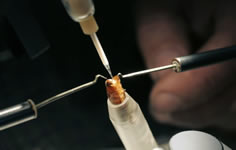
I’d like to share with you some of the methods and procedures that my wife Suki and I use to produce instrumentally inseminated queens on a commercial scale. Together we produce about 2000 queens a year. In the last 30 years of raising queens we have learned some hard lessons, and so hope that perhaps someone here today may benefit from our experience.
Queen rearing is one of those small things that has a very large effect on determining what kind of bees inhabit the world. Unlike the breeding of dogs and cats where we have assumed their total care and feeding, bees are still self sufficient, wild animals. Their long term success and ours depend on them being able to take care of themselves. Bees have been surviving on their own for millions of years without our care, and we really shouldn’t get in the way of their adapting to a changing world. But we’ve done just that by allowing them to become dependent on our chemical treatments for their pests and diseases.
The fact that varroa mites are now resistant to several of our chemicals should be a lesson for us. Our bees can also become resistant by the using the same evolutionary mechanisms. The mites have some advantage in this arms race because of their shorter generation time. But I believe that we can help the bees by accelerating the spread of mite resistance genes, and instrumental insemination is a tool which can be used towards that end.
Our top priority is to propagate and sell breeding stock that is resistant to mites and diseases as well as being productive and beekeeper friendly.
The Big Picture
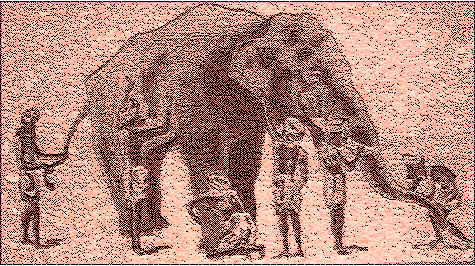

The longer I study bees the more I realize that we are all like the blind men examining the elephant in this old parable. We’re all looking at honeybees from our own point of views, from DNA molecules to ecosystems, and we can only get a handle on the big picture by learning from others and sharing what we’ve learned. That’s what Apimondia and science itself is all about.
Today the latest DNA and information technologies are being applied to honeybees to know them at an even deeper level. Astounding discoveries are starting to be made, it’s a very interesting time to be a beekeeper. Many of these scientific applications require the precise control of mating through the use of instrumental insemination.

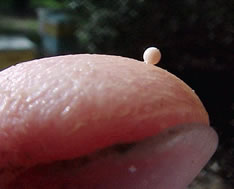 It should be noted that instrumental insemination of queen bees is different from artificial insemination of other animals. Our goal is not to fertilize one egg with one sperm, but just to get millions of sperm stored into the queen’s spermatheca. The queen actually fertilizes the eggs by releasing 5-10 sperm onto the egg at the time it is laid. Five million sperm need to be stored so that the queen can lay perhaps 1/2 million eggs over her lifetime. Fortunately bee sperm are very good at migrating to the spermatheca so instrumental insemination works with a high rate of success.
We need to keep in mind just how important the queen is. Between her own genome and the genomes of the 10-20 drones she mates with, all of the traits of a colony are determined. So contained in the fertilized queen is all the hard earned information that has allowed bees to survive for millions of years. This information in the form of DNA is truly a treasure that needs to be preserved as much as possible, even as we try to breed for specific traits.
It’s amazing to think that all of us as beekeepers hold the key to bees of the future. By choosing the queens which head our colonies, we are all involved in nothing less than the evolution of the honeybee species, and we need to take our actions very seriously.

 Honey bee pollinating an avocado blossoms
Test apiary in a Fallbrook avocado grove
 Queen nuc apiary
Queen rearing apiary
The location of Glenn Apiaries is in southern California, about 100 km north of San Diego. The Mediterranean climate gives us a long season for raising queens, from February to September. Nearby crops include citrus and avocado, but mostly the bees depend on the native chaparral plants.
Beekeeping for us is a lifestyle, not just an occupation. We live with the bees right out the back door. A small travel trailer is used as my lab for inseminating the queens. We are not migratory, and about one hundred colonies are kept at home and used for queen rearing, drone rearing, and nucleus colonies to start the queens laying. Another 300-400 colonies are kept year round in nearby avocado groves as test colonies. All of the bees are kept within about 20 km of home.
Inseminated Queen Production
 Our system of producing inseminated queens is a steady stream of production once it begins. We start grafting queens when the colonies begin raising drones. They do this on their own schedule. Queens are grafted nearly everyday, so all the steps along the process also have to be done each day. It’s similar to a dairy farm where a daily routine must be maintained for things to work smoothly.
The system is complex in that there are many steps, but once it is broken down into routines and subroutines it is manageable with the proper record keeping. Record keeping is all important, not only to maintain the integrity of any breeding system, but to make things simple, and to save time and frustration. The more logic that can be built into the records, the less thinking is required. Our system is very much like a library, with each queen positively identified with a number, and her location and relationship to other queens known.
When you control the mating there is no need to keep different lines of bees geographically separated. This is a big advantage over programs using natural mating. Another advantage is that mating weather becomes irrelevant.
It only makes sense to begin with the best stock available. Breeding by it’s nature is a cooperative activity. Fortunately, there are some dedicated scientists who are developing lines of bees that are now successful at resisting mites and diseases. We have ongoing exchanges with some of these researchers so we start with the most state of the art stock. We then try to add value thru our own selection based on collected data on mite resistance and performance.
Breeding is a little like writing software. The power comes from the fact that once a something of value is developed it can easily be copied and distributed. This is where the tool of instrumental insemination is valuable, as a means of copying and distributing genetic traits of bees that are deemed beneficial. We have entered an era in which we can think of queen bees as a means of biocontrol against mites and diseases.
Queen Rearing
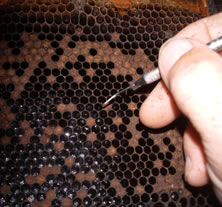
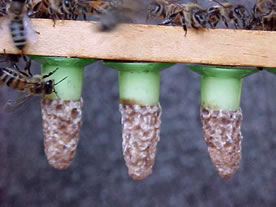
Modern queen rearing is actually very unnatural. In nature every queen tries to reproduce. It’s a system which maintains genetic diversity very well, but produces genetic changes slowly. For 150 years since we've learned how to artificially rear queens, we have been using a relatively small number of our best queens to try to effect desirable changes in the bees. But we do this at the expense of genetic diversity.
This is not necessarily bad if we are careful to spend this diversity wisely to get the bees we really want. The more information we have the better decisions we can make. The most important decision I make each day is which queens to graft from. Selection of the next generation is based on performance as well as pedigree.
My method of queen rearing is to simply use a strong queenless colony to start and finish from 16 to 48 cells at a time, depending on conditions. Four of these colonies are used in rotation, with a new graft going in every 4 days as the previous cells are just being capped. Brood from other colonies is added every 2-3 days to keep the population strong and young.


Unlike queens that will naturally mate, these queens will never fly. Queen cells are hatched into bottles in an  incubator. A small piece of queen candy is placed in the bottle to provide food for a few hours until the young queen can be transferred to a queen bank frame.

The bank frame has little doors for each of 55 queens. A metal bar securely locks the doors. The back of the frame is also covered with screen. After about a week when the queens are sexually mature, this frame will fit over a special box full of bees, which will feed the queens while they are outside the hive for the insemination process.

These queen bank frames are kept in the same colonies that the queencells are being raised in. They require the same strong queenless conditions, and surprisingly do not inhibit queen cells being raised just one frame away.

About Us | Site Map | |
This page is no longer being updated.
 Glenn Apiaries