 Glenn Apiaries

|
Mite Resistant Queens Adapted from a talk presented to the California State Beekeepers, November 2006 by Tom Glenn It has been about five years now that mite resistant stock has been widely available to beekeepers in this country. So it seems a good time to take a look at where we are and where we would like to go. There are at least half a dozen breeding programs going on now, attacking the mites from different angles. It is important to have a variety of sources to keep a diverse gene pool of resistant stock. Up front, in the interest of full disclosure, let me tell you that I make a living by selling mite resistant breeder queens. So of course you can expect me to put a positive slant on things. I hope to show that it is really in all or our best interest that we turn to using mite resistant stock. There are some other more objective sources of wisdom on
the subject besides my own opinion. First there is science which is probably
the most objective way we have of knowing things. Then there is what is
called the wisdom of the marketplace, how are people voting with their dollars.
Finally there is beekeepers personal experiences they have had using resistant
stocks of bees.
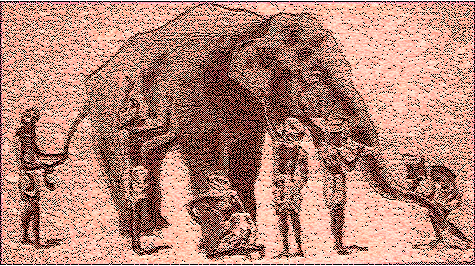
Bees are more complicated than this elephant. This elephant has one mother and one father. But a colony of bees has one mother and 10- 20 fathers, with thousands of individuals working for the collective good of the hive. With what we now know about pheromones and communication controlling bee behavior, a colony of bees is now considered to be one of the most complex natural systems in the world. It is this complexity that allows them to be so productive, and so interesting. Bees are really fantastic little creatures, and they produce what I consider to be the finest food on earth. You only have to look at all the positive references to honey in the Bible to see what a great reputation it has always had. I think it would be a crying shame if after thousands of years of beekeeping, our generation of beekeepers were the ones that let this reputation for purity slip away. It's worth our best effort to keep this from happening. As beekeepers today, we are a small group of people that have a great influence on the world, not only in food production but also in determining how bees and will be kept in the future.
We are lucky to have some top notch bee researchers devoting their lives to helping the bees become resistant to mites and diseases. The development of resistant lines of bees has been a real scientific success story. There are now well over a hundred scientific papers on the subject. Science is never finished, and scientists do not often come out and say anything is completely proven. But for me there is enough evidence to show that we now do have productive lines of bees that do keep the mite population down. My own experience agrees with this, that is why I am such a true believer in using mite resistant bees to control mites. But the job is not near over, we are just at the beginning of getting American bees resistant to mites. Someday I hope that mites will be considered a minor pest like wax moths, where the bees' own behaviors takes care of the problem. Honeybees have been around for 35 million years, they have seen parasites and diseases come and go. But buried in their genetic history are the solutions to some of their current problems. By developing resistant stock, we are really just helping the bees activate their own immune system. The sooner we do this the better for all.
John Harbo and Jeffery Harris at the USDA had been selecting bees for the presence of mites that were not reproducing, as in the pictures in the B column. It was thought that there must be something in the baby bee that was causing the mites to be infertile, hence the name SMR, suppressed mite reproduction. Marla Spivak and her one of her students, figured out that the reason that only non reproductive mites remained, was that the pupae that did have reproductive mites had been removed by hygienic behavior. It was a nice piece of detective work, and now it is pretty well accepted that this is what is going on with the VSH trait. Bees with the VSH remove egg-laying mites from capped brood cells (A), AND do not disturb cells with mites that do not lay eggs (B). The benefits of having bees that can handle the mites are clear and compelling. Just imagine if you did not have to buy any mite treatments, and did not spend any time applying them. How could you use that time and money in more productive ways. Without treatments you would never have to worry about honey getting contaminated, or there being negative side effects on the bees and queens. Not to mention the hazards to us beekeepers. I will never forget the day I decided to stop treating my bees. It was back in 2001, and I was about to take a bite out of a beautiful piece of burr comb, when I realized I had a coumaphos strip in the hive and I really did not want that in my body. I remember thinking, how pathetic is this, a beekeeper afraid to eat his own honey. We all know that there is no such thing as a free lunch. And at least in the case of hygienic behavior, we know what the cost is. For each mite family that is removed from a brood cell, a bee pupae is also removed. The pupae may be consumed and the protein recycled, but this is still a heavy price to pay. The time, space and resources invested in raising that baby bee comes at the cost of hive productivity. Of course, the fewer mites in the hive, the lower the cost in terms of brood sacrificed. Ideally, the goal is to reduce the mite load in all colonies, and so keep this cost of mite resistance low. The time and money spent developing resistant stock has
now largely been paid. Of course, programs have to be ongoing, but now the
infrastructure is in place, and the focus can be on further improvements.
About 10 years later Woodrow identified the mechanism as hygienic behavior, the uncapping and removal of diseased brood. Rothenbuhler and his students did the landmark studies and came up with a two recessive gene model. Today we think it is a bit more complicated, being controlled by perhaps 7 genes. Steve Taber and Martha Gilliam at the USDA in Tucson did a lot to bring the benefits to the attention of beekeepers. But it really was not until Marla Spivak, developed and distributed her own stock, that hygienic behavior really got into mainstream use. The fact American foulbrood finally became resistant to the antibiotic Terramycin, reminds us that we would have been far better off if back in the 1940s they had developed and started using hygienic bees. We would have bypassed all the problems and expense of taking the antibiotic route to controlling diseases. But the 1940s were the time when antibiotics were considered miracle drugs. Beekeepers did not know they were stepping onto a treadmill, and getting in the way of the bees solving their problem.
People in agriculture have to be pragmatic, if you are not you will not survive long. Even though today it seems like 15 years was a long time for a switch to something better, these are the types of lag times that we are dealing with. This corn study turned out to be a model of how most changes occur in society. Just the time frame changes. So maybe we can use this information to predict what might happen with the use of resistant bees. There are a couple big differences between corn and honeybees. First, beekeepers cannot see what is going on in neighboring hives. It is hard enough knowing what is going on in your own hives, let along those of everyone else.
This graph shows that as of July 2006 more than half of the queen producers advertising in the American Bee Journal and Bee Culture were offering resistant stock of one sort or another. This chart is not very accurate because it is not weighted by the number of queens each producer sells. Some of the largest producers are not selling resistant queens. On the other hand, I know that some producers are using resistant breeders, but are not advertising it. Also I know from our own customer list for breeder queens, that besides these 51 commercial queen producers, there are hundreds of beekeepers raising their own queens, or have them for sale on a small basis. So after five years, I think it is safe to say that they are being given a fair test by beekeepers. Apparently at this point, a good number of beekeepers are voting with their dollars and using resistant bees. I would say we have a good start in getting all of our bees resistant to mites.
The amazing thing is that beekeepers have so much control over this genetic network. Except for the few feral colonies around, we determine which queens are in the hives. And when you control the queen, you control the colony. If we decide to make changes in this genetic network, we already have the tools to do so.
We are really in uncharted territory in this endeavor to make the whole bee population resistant to mites. So nobody really knows how it will progress. If we are dealing with a recessive trait, both the queen and the drones she mates with have to carry the genes. The more hygienic drones are out there, the more hygienic the bees will be. Requeening with hygienic queens is the key, she will produce drones carrying the hygienic genes. It is in all of our best interest that the bees be hygienic. If we are ever going to get past the mite problems, we are going to have to use our bees intelligently. Each beehive counts in the big picture. Just because you are not ready to stop mite treatments, does not mean you should not use resistant bees. Let them be your second line of defense, while you build the bees for a better future. When your bees become hygienic you will notice the absence of chalkbrood and American foulbrood. That alone is reason enough to use them. The beauty of this solution is that it costs no more to raise a resistant queen than a non-resistant queen. It is just a decision each beekeeper must make when he decides which queens to buy. So when weighing the costs and benefits, don't forget the benefit to the collective good of the bees and beekeepers in the future. It sometimes seems like California is the center of all bee activity. With almond pollination driving the industry these days, the state is literally being invaded by bees from all over the world. Along with the bees come all their pests and problems. American beekeepers are an independent lot. It is hard to get them to all look at things the same way. But I think if we all take a long term view, we can agree that the best solution is to work with nature to help keep the bees the wonderful self sufficient creatures they have always been. It is in our own best interest. Imagine the peace of mind of having a permanent solution to the mite problem. A solution that allows us to focus other aspects of productive beekeeping, like producing all the bees the almond growers are going to need in the near future.
From my point of view beekeepers have one major goal, and that is to get the bees through this tough time of mite problems. I believe that using mite resistant stock is the best way to achieve this goal both for the bees and the beekeepers.
|
Beginning beekeepers click here for advice on getting started in beekeeping.What's happening in the Bee World |



 There was a similar situation back in 1928 when hybrid
corn was introduced to farmers by the USDA. Hybrid corn seems like a slam
dunk to us now. It gave an instant 20% increase in yield, plus it stood
up to drought better and grew more consistently, so was easier to harvest.
There was a famous study done of how farmers adopted the use of the new
improved corn. They found that despite all the science behind it, only a
few farmers planted it early on. These they termed innovators and for some
reason they decided it looked good enough to take the risk and try it .
It was a big risk too, because a farmer was literally betting the farm on
a new idea like this, he doesn't take it lightly. As other farmers saw that
the innovators were not going broke, some of them started to test it also.
Typically a farmer planted part of his fields for 3 or 4 years before he
turned all his fields over to it. As early adopters came on board, more
evidence accumulated for the late adopters who had a lower tolerance for
risk. By 1943 even those who had to be dragged into the future kicking and
screaming were planting hybrid corn.
There was a similar situation back in 1928 when hybrid
corn was introduced to farmers by the USDA. Hybrid corn seems like a slam
dunk to us now. It gave an instant 20% increase in yield, plus it stood
up to drought better and grew more consistently, so was easier to harvest.
There was a famous study done of how farmers adopted the use of the new
improved corn. They found that despite all the science behind it, only a
few farmers planted it early on. These they termed innovators and for some
reason they decided it looked good enough to take the risk and try it .
It was a big risk too, because a farmer was literally betting the farm on
a new idea like this, he doesn't take it lightly. As other farmers saw that
the innovators were not going broke, some of them started to test it also.
Typically a farmer planted part of his fields for 3 or 4 years before he
turned all his fields over to it. As early adopters came on board, more
evidence accumulated for the late adopters who had a lower tolerance for
risk. By 1943 even those who had to be dragged into the future kicking and
screaming were planting hybrid corn.  One way to get an unbiased assessment of where we are
today in the use of resistant bees is to look at what is going on in the
marketplace, how are beekeepers voting with their dollars. Commercial queen
producers pretty much respond to the demands of their customers.
One way to get an unbiased assessment of where we are
today in the use of resistant bees is to look at what is going on in the
marketplace, how are beekeepers voting with their dollars. Commercial queen
producers pretty much respond to the demands of their customers. There is another big difference between corn and honeybees.
With hybrid corn, it really did not matter to farmer Smith, what farmer
Jones grew in his field. His yield is the same whatever his neighbor plants.
But with bees it really does matter what is in other beekeepers hives. Because
whether we realize it or not, each hive is part of a genetic network. Drones
from your hives are mating with queens from neighboring hives, and feral
drones mate with your queens. We are all painfully aware of how often queens
are superceded these days. These queens are mating with drones from miles
away. You may not think that you are involved in bee breeding, but in fact
we all are. We either have a positive affect or a negative affect on the
whole gene pool.
There is another big difference between corn and honeybees.
With hybrid corn, it really did not matter to farmer Smith, what farmer
Jones grew in his field. His yield is the same whatever his neighbor plants.
But with bees it really does matter what is in other beekeepers hives. Because
whether we realize it or not, each hive is part of a genetic network. Drones
from your hives are mating with queens from neighboring hives, and feral
drones mate with your queens. We are all painfully aware of how often queens
are superceded these days. These queens are mating with drones from miles
away. You may not think that you are involved in bee breeding, but in fact
we all are. We either have a positive affect or a negative affect on the
whole gene pool.

